
Tranexamic Acid
A synthetic amino acid derivative modeled on lysine, widely used in brightening cosmetics for a more even-looking skin tone.
- INCI name
- Tranexamic Acid
- Chemistry
- trans-4-(Aminomethyl)cyclohexanecarboxylic acid; C8H15NO2; MW 157.2; CAS 1197-18-8
- Mode of interest
- Occupies the lysine-binding sites of plasminogen, studied for its effect on UV-related pigmentation signals
- Properties
- Highly water-soluble and stable; suits serums, toners and creams. Derivatives such as cetyl tranexamate improve skin affinity
History
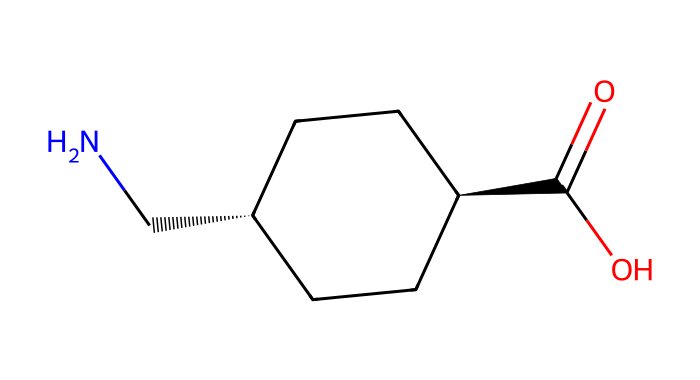
Tranexamic acid (TXA) is a synthetic amino acid derivative modeled on the structure of the essential amino acid lysine. It was developed in 1962 by the Japanese husband-and-wife team Utako and Shosuke Okamoto as a hemostatic (antifibrinolytic) agent and remains widely used in clinical practice today [1].
In 1979, a report from Japan described the fading of melasma in a patient taking tranexamic acid for hemostasis, drawing attention to it in the field of skin pigmentation [2]; research on topical formulations followed. In Japan, it was approved as an active whitening ingredient for quasi-drugs in 2002 [3].
Why it is studied for tone
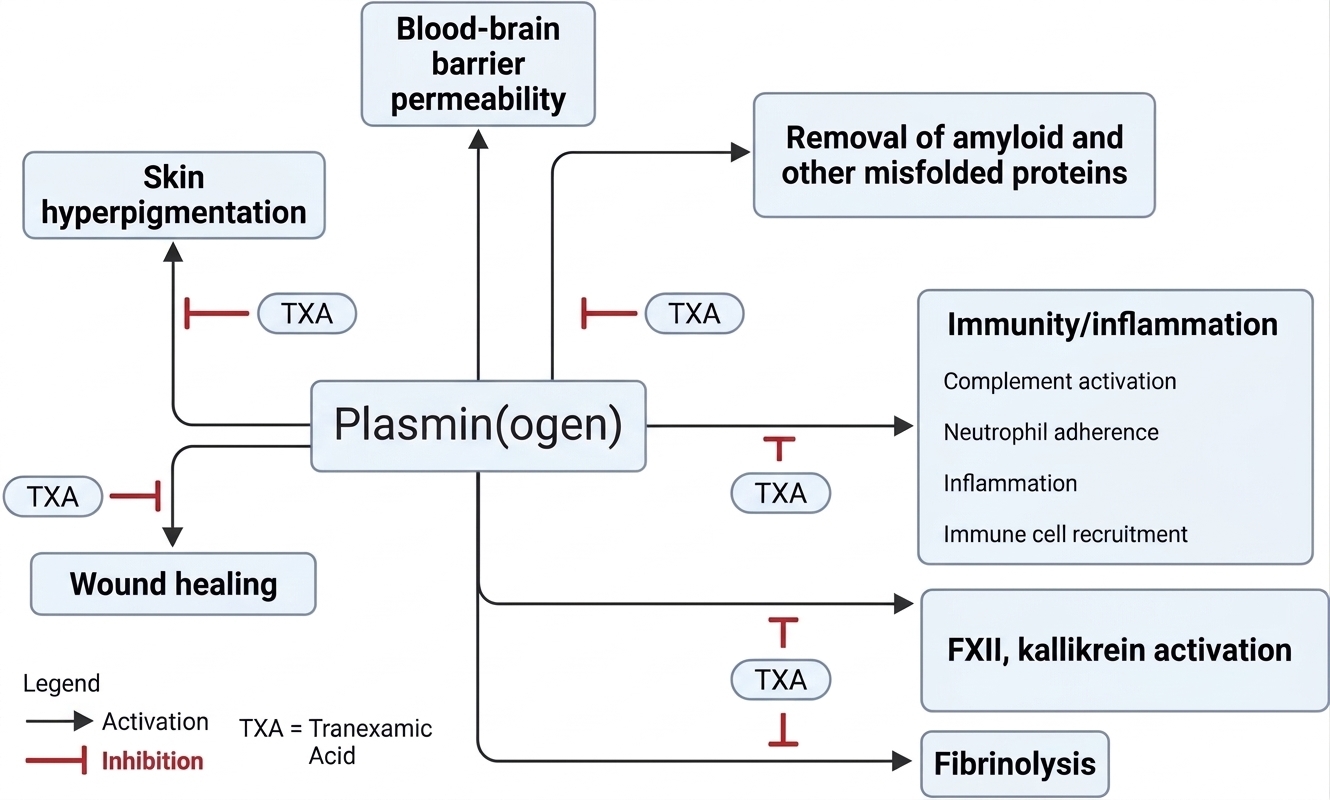
In published research, UV exposure raises plasminogen activator in keratinocytes, converting plasminogen to plasmin. Plasmin increases signals such as arachidonic acid, prostaglandins, α-MSH and bFGF that stimulate melanocytes. Tranexamic acid occupies the lysine-binding sites of plasminogen and interrupts this sequence [4,5]. Rather than acting on melanocytes directly, it dampens the signals from surrounding cells [3,6,7].
Its vascular effects have also been characterized. In a study analyzing skin tissue after 12 weeks of topical 2% tranexamic acid, epidermal melanin decreased significantly, vessel number (CD31) and VEGF showed a decreasing trend, and endothelin-1 decreased [6]. Tranexamic acid has also been reported to reduce dermal mast cell counts and angiogenesis [7]. In other words, rather than directly inhibiting melanocytes, tranexamic acid works by dampening the signals from keratinocytes and the perivascular environment that stimulate melanogenesis [3].
Topical studies have mostly used 2–5% over 12 weeks, and comparative studies reported less irritation than older brightening agents. It is commonly formulated together with other brightening ingredients.
Properties of Tranexamic Acid
- A unique mechanism: in published research, as a lysine analog, it interrupts the plasminogen–plasmin pathway
- Widely studied in melasma-type hyperpigmentation, in which UV, inflammatory, and vascular factors are intertwined; in cosmetics, used for a more even-looking skin tone
- In published studies comparing it with hydroquinone, similar improvement was reported with less irritation [9,10]
- Highly water-soluble and stable, suitable for a wide range of formats including serums, toners, and creams
- Derivatives with enhanced skin affinity, such as cetyl tranexamate, have also been developed and are in use [3]
Research Findings: Clinical Studies of Topical Tranexamic Acid
The studies below are published research by independent teams on tranexamic acid itself, not studies of StemCello products. In clinical studies on topical tranexamic acid conducted by various research teams, concentrations of 2–5% were primarily used over a 12-week period; the clinical outcomes are summarized in a table (Table 1).
Table 1. Summary of Key Clinical Studies of Topical Tranexamic Acid
| Study | Design / Subjects | Treatment | Duration | Key Findings |
|---|---|---|---|---|
| Kanechorn Na Ayuthaya et al., 2012 [8] | Double-blind, randomized, split-face; 23 Asian women (21 completed) | 5% TXA gel vs. placebo gel, twice daily + sunscreen | 12 weeks | MASI decreased on both sides; no significant difference vs. placebo. More erythema on the TXA side |
| Ebrahimi & Naeini, 2014 [9] | Double-blind, split-face; 50 subjects | 3% TXA vs. 3% hydroquinone + 0.01% dexamethasone | 12 weeks | MASI decreased in both groups; no between-group difference. Fewer adverse events on the TXA side |
| Kim SJ et al., 2016 [6] | Open-label; 23 subjects (biopsy in 10) | 2% TXA, full face | 12 weeks | mMASI improved in 22 of 23 subjects; skin brightness (L*) increased, redness (a*) decreased |
| Atefi et al., 2017 [10] | Double-blind, randomized; 60 women | 5% TXA vs. 2% hydroquinone, twice daily | 12 weeks | Similar MASI improvement. Satisfaction: TXA 33.3% vs. 6.7% (p=0.015); no adverse events in the TXA group |
| Kim HJ et al., 2017 (meta-analysis) [11] | 11 studies, 667 subjects (oral, topical, and injectable) | TXA alone or combined with conventional therapy | — | Mean MASI reduction of 1.60; additional 0.94 reduction when added to conventional therapy; mild adverse events |
Source: Compiled by BioSpectrum based on references [6, 8–11]. MASI: Melasma Area and Severity Index
The studies are relatively small, and in some placebo-controlled comparisons no significant difference was observed [8]. In studies comparing it with hydroquinone, tranexamic acid showed similar improvement with less irritation, so it is commonly formulated together with other brightening ingredients.
Safety
Topical tranexamic acid is generally low in irritation, although mild erythema or transient irritation has been reported in some studies [8,11]. A risk assessment by the Norwegian Food Safety Authority judged use at 3% in facial creams and masks to be safe [12]. Thrombosis-related precautions for oral administration apply to systemic doses and are distinct from topical cosmetic use.
Where it is permitted
| Region | Status |
|---|---|
| Korea | Permitted cosmetic ingredient. Not on the MFDS list of notified whitening functional ingredients; a functional claim requires separate data review. |
| Japan | Approved in 2002 as a quasi-drug whitening active (Shiseido “m-tranexamic acid”); cetyl tranexamate approved in 2008. |
| EU | Listed in CosIng (astringent, skin conditioning); no specific use restrictions. |
| ASEAN | Up to 3.0% in skin products; prohibited in products for mucous membranes (ASEAN Cosmetic Directive Annex III). |
- Okamoto S, Okamoto U. Amino-methyl-cyclohexane-carboxylic acid: AMCHA. Keio J Med 1962;11(3):105-15.
- Nijo S. Clin Res 1979;13:3129-31 (Japanese; cited via reviews).
- Maeda K. Timeline of the development of skin-lightening active ingredients in Japan. Molecules 2022;27(15):4774.
- Sheu SL. Cutis 2018;101(2):E7-E8.
- Maeda K, Naganuma M. Topical trans-4-aminomethylcyclohexanecarboxylic acid prevents ultraviolet radiation-induced pigmentation. J Photochem Photobiol B 1998;47:136-41.
- Kim SJ, et al. Clin Exp Dermatol 2016;41:480-5.
- Na JI, et al. J Eur Acad Dermatol Venereol 2013;27:1035-9.
- Kanechorn Na Ayuthaya P, et al. Topical 5% tranexamic acid for the treatment of melasma in Asians: a double-blind randomized controlled clinical trial. J Cosmet Laser Ther 2012;14(3):150-4.
- Ebrahimi B, Naeini FF. Topical tranexamic acid as a promising treatment for melasma. J Res Med Sci 2014;19(8):753-7.
- Atefi N, et al. Therapeutic effects of topical tranexamic acid in comparison with hydroquinone in treatment of women with melasma. Dermatol Ther (Heidelb) 2017;7(3):417-24.
- Kim HJ, et al. Efficacy and safety of tranexamic acid in melasma: a meta-analysis and systematic review. Acta Derm Venereol 2017;97(7):776-81.
- Norwegian Food Safety Authority (Mattilsynet). Risk profile: Tranexamic acid. 2012.
- Legal Notice: Although scientific and medical terminology is used in this description, it is intended to help consumers understand the ingredient introduced and was not written to suggest that products containing this ingredient have medical or therapeutic effects. The scientific information presented is based on objective facts grounded in published papers, and the literature referenced is cited for the key content. Ingredient research data do not represent the effects of a finished product.
- Republic of Korea: Products containing this ingredient are cosmetics that use only ingredients permitted for cosmetic use and comply with the Cosmetics Act and related regulations.
- United States: Products containing this ingredient are cosmetics that use only ingredients permitted in cosmetics and comply with applicable U.S. cosmetic regulations, including the Federal Food, Drug, and Cosmetic Act (FD&C Act) and the Modernization of Cosmetics Regulation Act of 2022 (MoCRA).